
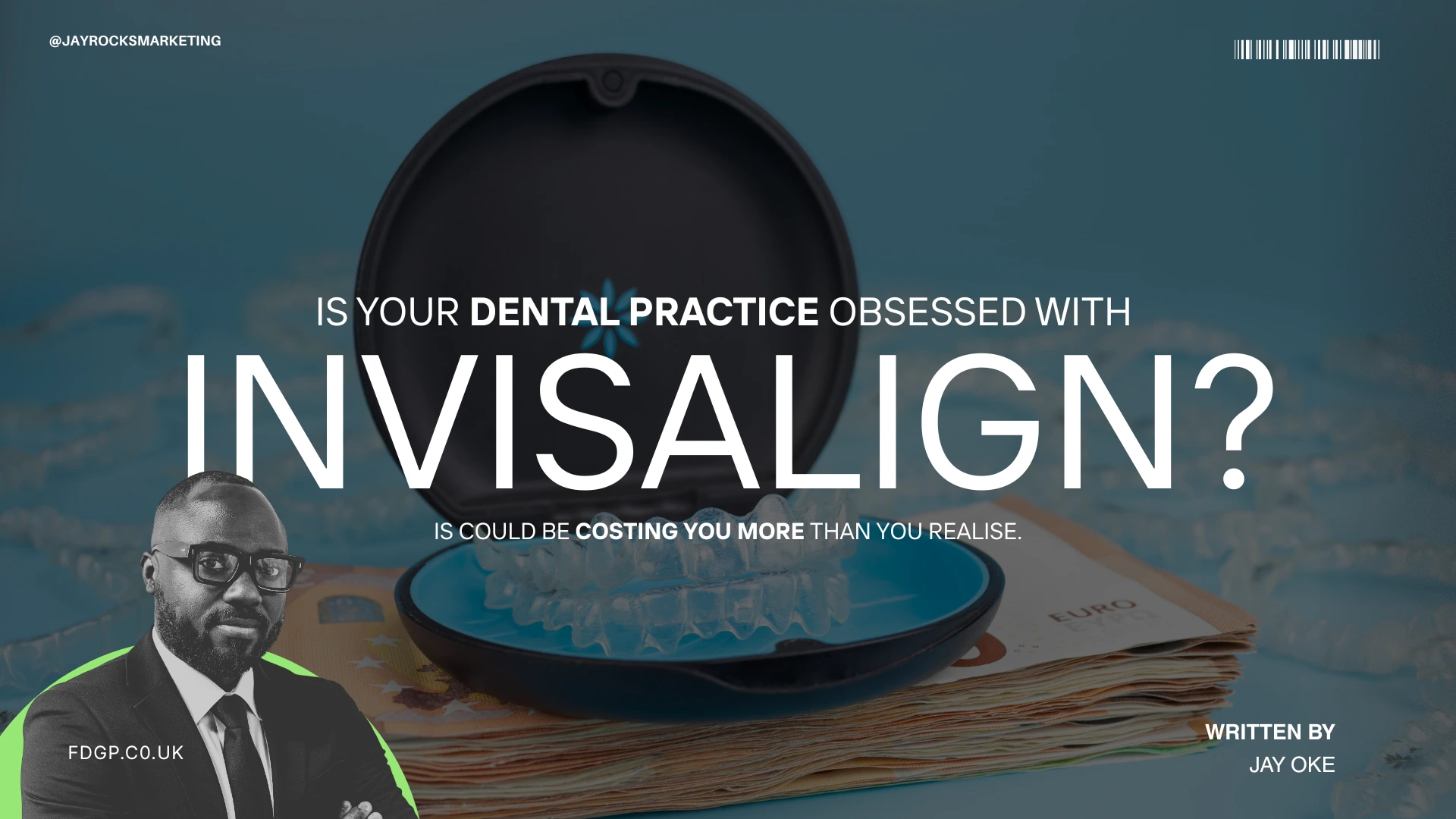
Why Every Dental Practice Thinks Invisalign Is the Answer (And Why That Thinking Is Quietly Limiting Your Growth)
There is a moment that happens in almost every dental marketing conversation I have with a practice owner. We are talking about growth, about new patient flow, about how to build sustainable revenue, and within five minutes the same two words appear: Invisalign Open Day.
And I get it. Genuinely. Invisalign has done extraordinary work in building consumer demand. The brand is trusted, the product works, and the open day format gives practices a structured way to generate interest and fill their diary with high-value cases. For many practices, it has been a genuine turning point in their growth story.
But here is the question I always ask next, and it rarely gets a comfortable answer: what is your strategy if Invisalign becomes a commodity in your market?
Because in many parts of the UK, it already has.
When a Growth Strategy Becomes a Race to the Bottom
There is a concept in business strategy called a red ocean. It describes a marketplace so crowded with competitors chasing the same customers that the only real lever left is price. Everyone offers the same thing. Everyone runs the same promotions. Everyone discounts to stay in the game. And slowly, the margins that made the treatment worth pursuing in the first place begin to disappear.
Invisalign, in many towns and cities across the UK, has quietly entered that territory.
Walk down a high street in any reasonably sized town and you will find three or four practices all running Invisalign campaigns simultaneously. They are all advertising free consultations. They are all competing for the same search terms on Google. They are all targeting the same demographic on Facebook and Instagram. The patient, quite reasonably, starts to shop around. And when patients shop on price, practices begin to discount. And when practices discount to compete, the revenue per case drops, the cost of acquisition climbs, and the treatment that was supposed to be your growth engine starts to feel more like a treadmill.
I have seen this with practices I have worked with directly. The Invisalign funnel looks healthy from the outside, but when you strip back the ad spend, the discounting, the chair time, the follow-up, and the admin, the actual profit margin on each case can be considerably lower than the headline revenue figure suggests.
This is not an argument against clear aligner treatment. It is an argument against building your entire marketing strategy around a single branded product in a saturated market.
How can a dental practice generate new patients without relying on Invisalign campaigns?
Dental practices can attract new patients by diversifying their treatment marketing across composite bonding, teeth whitening, and porcelain veneers, alongside consistent investment in Google Ads for dentists, Meta Ads targeting local audiences, and local SEO to capture patients actively searching in their area. A multi-treatment marketing strategy reduces dependency on any single product and creates more resilient patient acquisition pipelines.
The Patient You Have Stopped Talking To
Here is something that gets lost when a practice becomes laser-focused on one premium cosmetic treatment: a significant portion of the patients in your local area are not ready for, cannot currently afford, or are simply not interested in straightening their teeth.
Some of those people are nervous patients who have not seen a dentist in years. They are not looking for a smile transformation. They are looking for a practice that will not make them feel judged for the gap. Some are young professionals who are happy with their alignment but quietly self-conscious about the colour or condition of their teeth. Some are parents managing a household budget who would love to invest in their smile but cannot stretch to four figures this year. Some are people who just want a small cosmetic fix, something quick, something affordable, something that makes them feel a little more like themselves when they catch their reflection.
These are not lesser patients. These are not patients to file away for some future campaign. These are real people with real dental needs and a genuine willingness to spend, if only the right practice would speak to them in the right way.
If your marketing strategy only shouts about Invisalign, the rest of them walk past.
The best new patient generation strategies for dental practices are not built on one treatment. They are built on a clear message for every type of patient, at every stage of their journey.
What are the best lead generation strategies for dental practices in 2026?
The most effective lead generation strategies for dental practices in 2026 combine Google Ads targeting high-intent search terms like “dentist near me” and specific treatments, Meta Ads on Facebook and Instagram for visual cosmetic treatments, local SEO to rank for location-based searches, and a diversified treatment menu that speaks to patients at every budget level. Practices that combine all three channels consistently outperform those relying on a single campaign type.
Three Treatments That Deserve More of Your Marketing Budget
I have been making this case to practice owners for a while now, and the data from the practices we work with continues to back it up. There are treatments already on your menu that, with a more intentional marketing approach, could be doing considerably more work for your revenue and your patient acquisition pipeline.
Composite Bonding
This is the treatment I talk about most often, and for good reason. The patient cost sits at a level that does not require a lengthy financial conversation or a payment plan. The chair time is short relative to more complex restorative work. The results are immediate, visible, and highly shareable on social media. For practices looking to build consistent monthly cosmetic revenue without the open day format, composite bonding is one of the most underused tools available.
It also represents a genuine opportunity to own a space that is not yet saturated in many markets. A well-designed Google Ads campaign and a clear Meta Ads strategy targeting the right local audience can position your practice as the go-to destination for accessible cosmetic dentistry before your competitors work out what you are doing.
If you are not actively marketing composite bonding with the same energy you put into your aligner campaigns, you are leaving money on the table and patients with other practices.
Teeth Whitening
This is perhaps the most underestimated treatment on most practice menus. Done well, with a trusted partner brand behind you, teeth whitening can become a recurring touchpoint with patients who return for top-ups, refer friends and family, and naturally progress towards more involved cosmetic treatments over time.
The margins are reasonable, the chair time is minimal, and the emotional payoff for the patient is immediate. Smile confidence is not a superficial concern. For many patients, it is the very first step on a longer journey towards more significant investment in their dental health. A practice that understands this and builds a whitening strategy around it is not just selling a product. It is building a patient relationship that compounds over time.
From a lead generation perspective, teeth whitening also converts well at the top of the funnel because the price point removes the barrier of the high-ticket decision. It is an easy yes that opens the door to a longer conversation.
Porcelain Veneers
This treatment operates at a different tier and demands a different kind of marketing conversation. It is a premium, high-investment procedure and the patients who pursue it are often making a considered decision over months rather than weeks. But for practices in or near busy urban areas, particularly where there is a younger, social-media-active demographic, the appetite for the full aesthetic transformation is very real and very commercially significant.
The key is positioning and content. The right photography, the right before and after stories, and the right paid social strategy can make your practice the obvious choice for patients already researching this treatment in your area. Executed well, porcelain veneers can become a flagship offering that elevates the perceived value of your entire practice and attracts a patient demographic with both the desire and the means to invest.
None of these treatments require an open day. None of them require discounting to compete. All of them represent genuine patient needs already present in your community.
Are Meta Ads effective for dental practices promoting cosmetic treatments?
Meta Ads on Facebook and Instagram are highly effective for dental practices promoting visual cosmetic treatments such as composite bonding, teeth whitening, and veneers. The platforms allow precise demographic and location-based targeting, making it possible to reach local patients by age, interest, and behaviour. For treatments where the visual result is the selling point, Meta Ads typically outperform search-only campaigns in generating awareness and new patient enquiries.
What Does a Resilient Dental Practice Marketing Strategy Actually Look Like?
The most sustainable practices we work with think in terms of a patient journey rather than a single transaction. They are not asking which one treatment can anchor their entire marketing calendar. They are asking how to build a consistent flow of patients at every value level, so that regardless of what happens in the market, their chairs are full, their team is busy, and their revenue is predictable.
In practical terms, that means investing in Google Ads for high-intent patients who are already searching for specific treatments. It means running Meta Ads that build awareness and trust with patients who are not yet searching but are the right demographic and location. It means building a website designed to convert, not just to look impressive. And it means having a treatment menu and a marketing message that is genuinely welcoming to patients at every stage of their journey, not just the ones ready to spend four figures today.
We wrote about this in detail in our guide on the 3 types of marketing goals every dental practice should have in 2026, and in our breakdown of 10 proven ways to attract more new patients to your dental practice. The principles are consistent: diversify your channels, speak to every type of patient, and build systems rather than campaigns.
It is also worth reading our article on Google Ads vs Meta Ads for dentists if you are trying to decide where to focus your paid media budget, and our piece on low-ticket dental treatments and how practice owners use them to drive short-term growth, which covers exactly how to position accessible treatments as part of a broader acquisition strategy.
The “Care” in Healthcare Has to Mean Something
There is a point in this conversation that goes beyond marketing strategy, and I think it is worth making clearly.
When a dental practice builds its entire growth model around one premium treatment and markets almost exclusively to patients ready to invest in that treatment, something quietly shifts in the culture of the practice. The nervous patient who finally works up the courage to book an appointment feels like a low-value lead. The parent who can only afford a whitening treatment this year does not feel like a priority. The young patient who just needs a small composite fix before they can consider anything bigger does not feel seen at all.
And that matters. Not just ethically, but commercially.
The practices that grow most consistently over time are not the ones with the slickest Invisalign campaign. They are the ones that have built a genuine reputation for looking after people, at every stage, at every budget level. That reputation generates referrals. It generates loyalty. It generates the kind of patient relationships that do not show up in a single campaign’s conversion data but absolutely show up in the revenue figures over a three to five year period.
Do not let the obsession with one product quietly replace the care that should sit at the centre of your healthcare business.
How should a dental practice design its website to attract and convert new patients?
A dental practice website designed to attract new patients should load quickly on mobile, have clear calls to action on every treatment page, include genuine before and after photography, and be structured around the treatments patients are actively searching for locally. Combining a well-optimised website with Google Ads and a local SEO strategy is consistently one of the highest-performing new patient acquisition systems for private dental practices in the UK.
A Final Word on Building for the Long Term
This article is part of a series on how dental practice owners can build genuinely diversified, resilient marketing strategies that do not leave them exposed to the fluctuations of one treatment category or one product brand.
The opportunity available to most practices is considerably larger than their current strategy reflects. It just requires stepping back from the next open day, looking honestly at the full range of what you offer, and building a plan that speaks to every type of patient in your community with clarity, consistency, and genuine care.
Ready to Build a Marketing Strategy That Works Harder for Your Practice?
If this has sparked a conversation you have been meaning to have about the direction of your practice’s marketing, we would love to be part of it.
At Foxstern Dental Growth Partners, we work with independent dental practices and multi-site groups across the UK to build clear, strategic marketing plans that generate consistent new patient flow, reduce reliance on any single treatment campaign, and position your practice for sustainable long-term growth.
We offer a free discovery call with no sales pitch and no obligation. It is simply an honest conversation about where your practice is now, where you want it to be, and what a realistic path between those two points looks like.
Book Your Free Discovery Call →
Or if you would prefer to explore a little more first, here are a few articles that sit alongside this one:
- The 3 Types of Marketing Goals Every Dental Practice Should Have in 2026
- 10 Proven Ways to Attract More New Patients to Your Dental Practice
- Low-Ticket Dental Treatments: How Practice Owners Use Them to Drive Short-Term Growth
- Google Ads vs Meta Ads for Dentists: Which Platform Is Better for Your Practice?
- The 5-Step Framework to Systemise Your Dental Patient Journey