
How smart practice owners use Low-Ticket Dental Treatments to create momentum and short term growth
Let’s start with a familiar picture.
It’s a Tuesday afternoon.
Your chairs are half full.
The team is busy, but the diary still has gaps that shouldn’t be there.
You offer implants. Invisalign. Smile makeovers.
Yet the phone isn’t ringing the way you expect.
This is where low-ticket treatments quietly do the heavy lifting for your practice, not by making you rich overnight, but by creating momentum, trust, and opportunity.
Used properly, they are the engine that keeps the practice moving forward.
Used badly, they turn into a never-ending hamster wheel.
Let’s break this down properly.
What do we actually mean by “low-ticket” dental treatments?
Low-ticket treatments are often misunderstood.
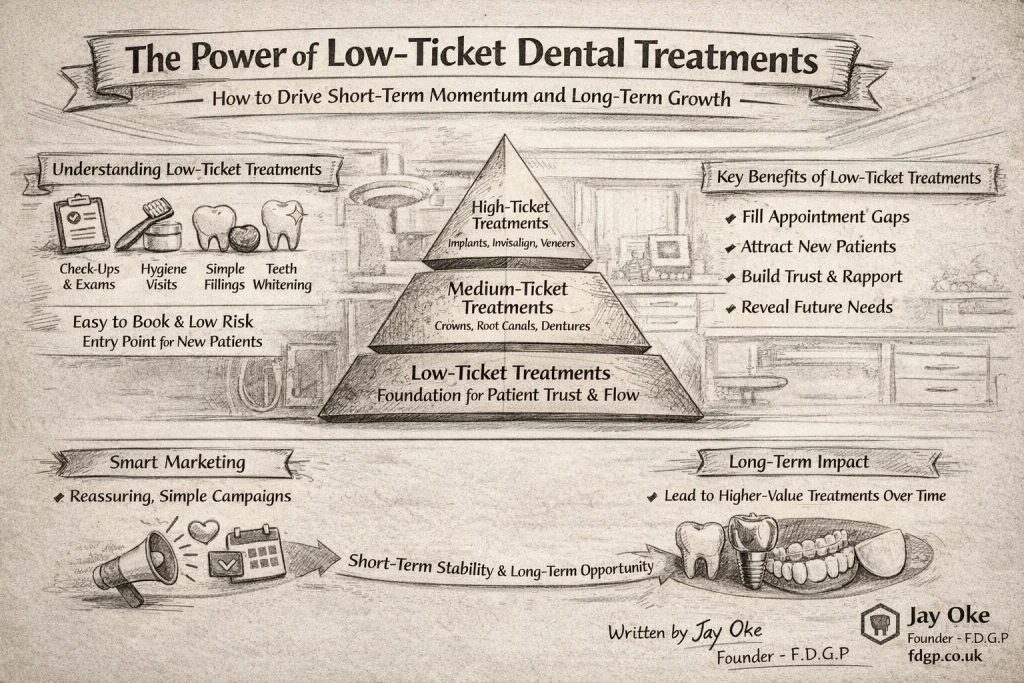
They’re described as “basic”, “entry-level”, or worse, “low value” while In reality, they are low risk from the patient’s point of view. Low-ticket treatments are entry-point services or dental treatments. They are quicker, lower cost, and easier for patients to say yes to.
Typical examples include:
- Dental examinations and consultations
- Dental Check-ups
- Hygiene appointments and scale & polish
- Simple composite fillings
- Teeth whitening
- Simple extractions
- Emergency pain consultations
They usually involve:
- One visit
- Minimal lab work
- Lower perceived risk for the patient
And that last point is crucial.
These aren’t impulsive decisions, they’re relief decisions. Patients booking these treatments aren’t thinking about your margins.
They’re thinking:
“Will this practice look after me?”
And that question is far more powerful than price. These decisions feel safe. Reversible. Low risk.
“Low-ticket treatments exist to meet patients exactly at this point. They remove friction, reduce anxiety, and allow people to experience your practice without commitment. From the patient’s perspective, this is not “cheap dentistry”. It is permission to begin.”
Low-ticket does NOT have to mean low value and here’s why
The first mindset shift most practice owners need to make is this, low-ticket treatments are not designed to maximise profit per appointment, they are designed to lower the barrier to entry.
Patients booking these treatments are not just buying a service, they are buying reassurance.
They are asking themselves:
- “Can I trust this practice?”
- “Do they explain things clearly?”
- “Do I feel comfortable here?”
If the answer is yes, everything else becomes possible.
The real role low-ticket treatments play in your practice
Low-ticket treatments exist to do four important jobs:
1. Fill the diary quickly –
First, they keep the diary moving. When a practice relies only on big cases, gaps appear fast. Low-ticket treatments smooth those gaps before they become a problem.
These treatments have short decision cycles. Someone in pain or overdue for a clean does not spend six months researching.
This makes them ideal for:
- Short-term campaigns
- Quiet periods
- New associate utilisation
2. Introduce new patients to your practice –
Second, they introduce new patients properly. Most long-term patients don’t arrive asking for implants. They arrive cautiously, often overdue, sometimes embarrassed. Low-ticket appointments give them a safe way in.
They start with:
- A check-up
- A hygiene visit
- A whitening enquiry
This is your first impression window.
3. Build trust before diagnosis –
Third, they create space for conversation. Trust isn’t built on treatment plans. It’s built when a patient feels listened to during a “simple” visit.
Patients rarely accept medium or high-ticket treatment from a practice they barely know.
Low-ticket appointments allow:
- Proper conversations
- Education
- Rapport building
4. Create ethical upsell opportunities –
And finally, they open doors. Not by selling, but by revealing. Issues surface naturally when someone finally feels comfortable.
This is not about pushing treatment.
It’s about:
- Identifying problems early
- Explaining options clearly
- Allowing patients to progress at their own pace
What are low-ticket dental treatments used for in a private practice?
Low-ticket dental treatments are mainly used to attract new patients, fill appointment gaps, and build trust. They create opportunities for longer-term care by introducing patients to come in and experience the practice before committing to more complex treatment.
How most practices get low-ticket marketing wrong
This is where things often fall apart. Some practices treat low-ticket treatments as disposable. They discount aggressively, rush appointments, and hope volume will make up for it.
Mistake 1: Treating low-ticket as “cheap dentistry”
Discount-heavy messaging attracts price shoppers, not long-term patients.
Low-ticket should feel accessible, not disposable.
Mistake 2: Running them all year, non-stop
If hygiene is your only marketing lever, the practice becomes:
• Busy but fragile
• Full but not profitable
Low-ticket marketing should be seasonal and intentional, not constant.
Mistake 3: No journey beyond the first visit
If a patient comes in for a check-up and leaves with:
• No plan
• No education
• No follow-up
You’ve missed the point entirely.
How low-ticket fits into a short-term marketing strategy
Low-ticket treatments work best when you treat them like a short-term lever, not a permanent crutch.
They work best when you need to:
- Fill diary gaps quickly
- Support new clinicians
- Re-activate lapsed patients
- Smooth out seasonal dips
Marketing channels that suit low-ticket treatments include:
- Google Ads for urgent intent
- Local SEO
- Email and SMS reactivation
- Simple social campaigns with clear messaging
The goal is not volume for volume’s sake. The goal is controlled flow.
When used properly, they stabilise the practice and when used constantly, they exhaust it.
Are low-ticket dental treatments profitable for a dental practice?
On their own, low-ticket dental treatments have lower margins. Their real profitability comes from patient retention, trust building, and their ability to lead to medium and high-ticket treatments over time.
Let me give you a secret: The quiet power of hygiene and check-ups
If you want one honest truth, here it is.
Hygiene appointments are often the most powerful growth tool in a dental practice.
Not because of what they earn but because of what they reveal.
They uncover:
- Gum disease
- Failing restorations
- Aesthetic concerns
- Bite issues
Handled properly, hygiene becomes the gateway to comprehensive care, not just a routine clean. The difference is not clinical skill. It’s how clearly the practice connects the dots for the patient and strategic referral.
How should dental practices market low-cost treatments without discounting?
Dental practices should market low-cost treatments by focusing on reassurance, clarity, and patient experience rather than price. Messaging should highlight comfort, professionalism, and long-term care rather than cheap offers.
Think of low-ticket treatments as the foundation. They don’t sit at the top of the revenue chart, instead, they sit underneath it, holding everything else steady. Without them, growth becomes unpredictable, however, with them, growth becomes intentional.
Where this fits in the bigger picture
Low-ticket treatments are not the destination.
They are the starting point.
They feed:
- Medium-ticket treatments like crowns, bonding, and endodontics
- High-ticket treatments like implants and orthodontics
Without them, growth becomes unpredictable.
A gentle reality check for practice owners
If your practice feels:
- Busy but stretched
- Full but underperforming
- Dependent on constant new leads
Ask yourself this:
Are your low-ticket treatments:
- Strategically placed
- Properly marketed
- Connected to a bigger journey
Or are they just “things you offer”?
Most practices don’t need more services. instead, they need better structure and s strategy towards the bigger picture.
Here is my recommendation for you:
Invest in this part of your patient journey.
Give your associate or treatment coordinator five extra minutes to discuss, refer, and recommend other treatments.
One of the biggest missed opportunities in dental practices has very little to do with marketing budgets, software, or technology.
It comes down to who is having the conversation, and how that conversation is handled.
Low-ticket appointments create the perfect moment to introduce patients to wider care. But that only works if the people on the front line feel confident doing it, and understand why it matters.
This is not about rushing treatment plans or turning every appointment into a sales pitch. In fact, it’s the opposite. Patients are far more open when they feel listened to, not pushed.
The most effective practices invest time in training their front-of-house teams and associates to recommend, refer, and educate subtly. Not to sell, but to guide. To spot interest. To plant a seed.
If an associate struggles with these conversations, that’s not a failure. It’s a signal. In those cases, the responsibility can be shared or shifted to a treatment coordinator or a well-trained front-desk team member with enough clinical understanding to carry the conversation forward calmly and confidently.
Yes, time is money. Every practice owner knows that.
But when a patient doesn’t feel valued or properly cared for, they don’t just delay treatment. They quietly disengage. And once that happens, no amount of follow-up or remarketing will bring them back.
Spending an extra five minutes explaining options, answering questions, or simply showing interest can be the difference between a routine visit and a £5,000 case accepted a week later.
The practices that grow sustainably are not the ones that rush. They are the ones that get good at spotting potential, slowing down at the right moments, and investing just a little more attention where it matters most.
Sometimes that conversation sits best with the associate. Sometimes with a treatment coordinator. Sometimes with a trusted front-of-house team member.
What matters is that it happens.
Need help structuring this properly?
If you’re not sure:
- Which low-ticket treatments to promote
- When to promote them
- Or how to link them to long-term growth
A practice audit can make this clear very quickly. It’s about building a system that actually fits your practice.
👉 Book a dental practice audit and we’ll map your treatments, diary flow, and marketing strategy together.
In the next article, we’ll move up a level.
We’ll look at medium-ticket dental treatments, the most overlooked revenue category in dentistry, and how they quietly determine whether a practice is stable or constantly under pressure.
If low-ticket treatments start the conversation, medium-ticket treatments decide how well the business actually runs.